See how it works
Choose a session, start, let go. That's it.
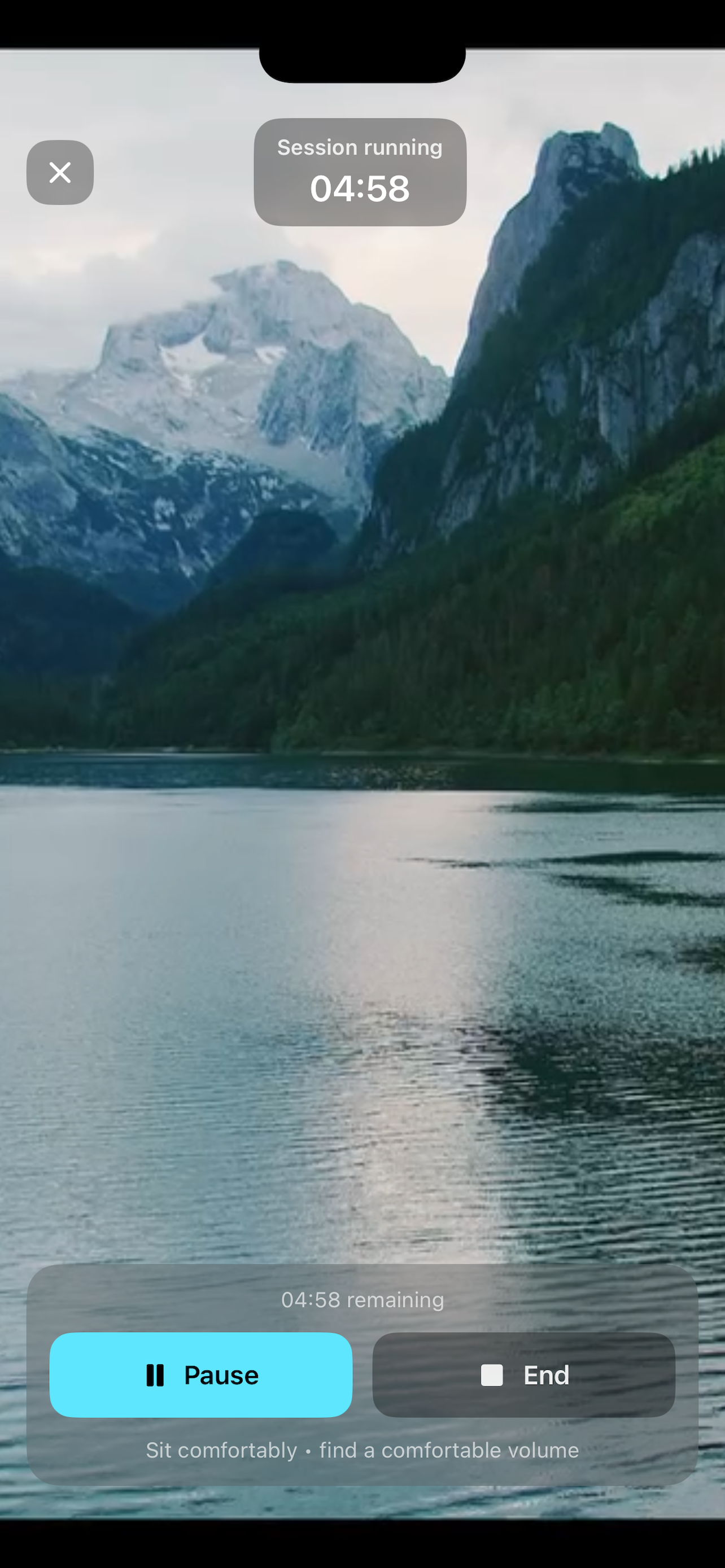
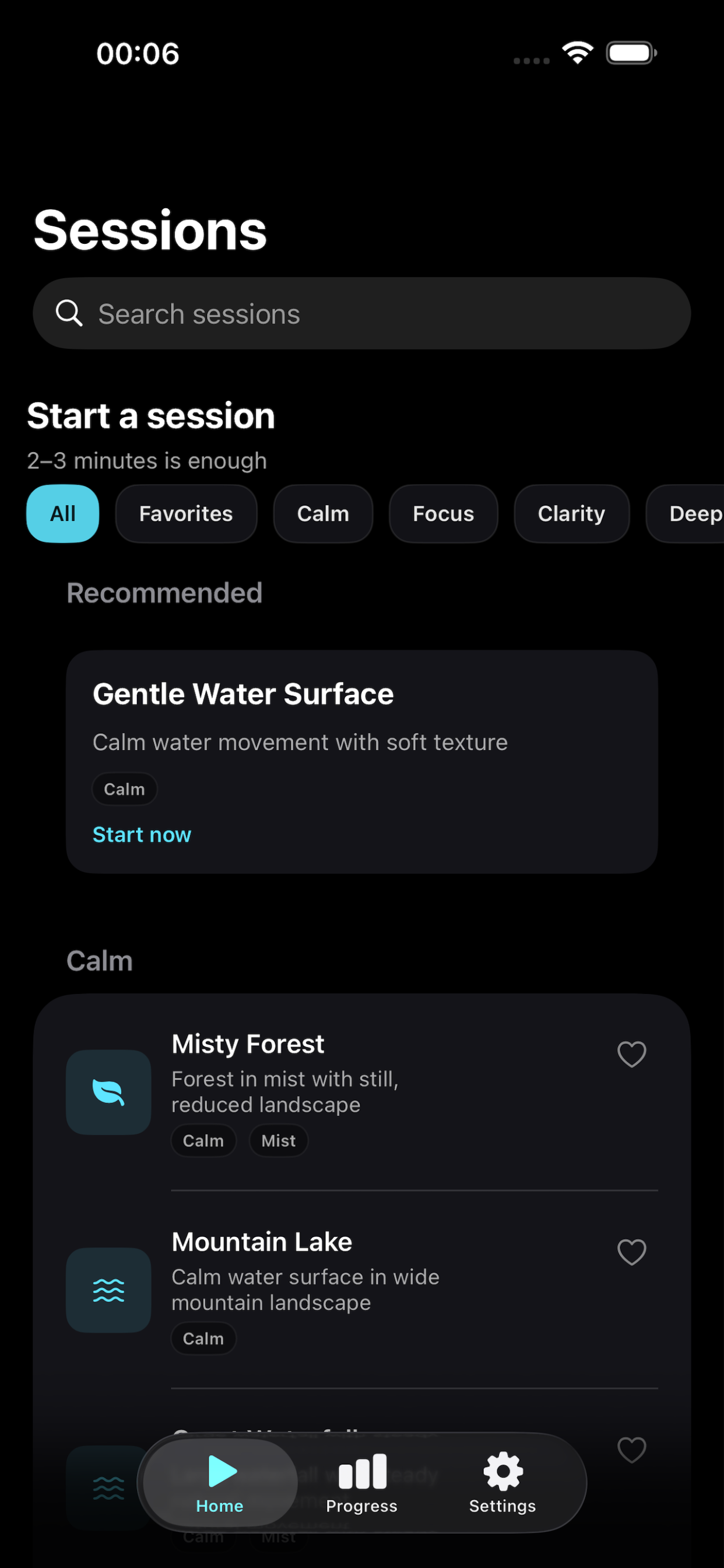

Seven categories, five frequencies – from focus and creativity to relaxation and sleep.
As an active session. Or quietly in the background while you work or fall asleep.
Choose by mood and goal – the app brings the matching frequency.
Alertness and energy – to start the day or before a task.
Gather your attention, clear your head. The best-researched range.
For moments when your thoughts are allowed to wander.
Finding your centre again when the day has been too full.
Winding down, releasing tension, slowing your pace.
Calm sleep sessions with a timer – you can put the phone away.
Every session can be used in two ways:
You watch a calm video for 5 to 45 minutes and consciously take that time.
How it feels differs from person to person – some notice it right away, others after a few sessions.
One tap on the moon icon and the screen goes dark. The music keeps playing while you work, read or fall asleep.
The vibration stays – you feel the rhythm even when there is nothing to see.
No warm-up, no learning curve. Start and carry on.
The human brain produces electrical oscillations across different ranges – from slow delta waves in deep sleep to fast gamma waves during high attention.
NeuroFocus picks up these ranges: each category uses a different frequency, matching the state you are looking for. The most intensively researched is the gamma range around 40 Hz, studied at MIT among others.
How you experience a session differs from person to person. You are most likely to notice it when you choose a category that fits your situation – and give it a few minutes.
More than a meditation app – for focus, sleep and mental activation.
Seven categories from Vitality to Sleep, each with its own frequency. You choose by feel.
The device vibrates in time with the frequency. So the rhythm reaches you through hearing, sight and touch at once – switchable, if you prefer it quieter.
Sleep sessions run with a timer – you fall asleep, the app stops. No manual stopping needed.
No learning curve, no preparation. Choose a session, start, let go.
Choose a session, start, let go. That's it.
5 minutes of session before work – as a conscious starting point for the day.
The music runs quietly in the background while you work, read or study. No video, no interruption – just switch it on and carry on.
Calm sleep audio session with automatic sleep timer. Set the timer, put your phone down – the app stops when you're asleep.
For anyone who wants short, clear sessions for focus, clarity and mental breaks – without a learning curve.
For anyone looking for a simple, calm routine in their day. Large buttons, clear structure, no learning curve.
NeuroFocus is inspired by ongoing research into rhythmic sensory stimulation. The most thoroughly studied is the gamma range around 40 Hz; there is also work on sensory stimulation in the alpha range around 10 Hz. For the other frequency ranges NeuroFocus uses, we rely on experience rather than studies.
The linked work reflects the state of research. It is not evidence for the effects of this app, but shows the context the idea sits in.
A widely cited study from the MIT/Picower environment examined how auditory 40Hz stimulation in an Alzheimer mouse model related to changes in neural activity.
Open study →More recent research examines how multisensory gamma stimulation may relate to biological processes such as neural activity and clearance mechanisms.
Open study →This review summarises the state of research on audiovisual gamma stimulation and carefully contextualises preclinical findings alongside early clinical approaches.
Open review →A review of audiovisual stimulation in the alpha band describes how alpha activity can be influenced by rhythmic stimuli, and puts possible applications in context.
Open review →Important: NeuroFocus is not a medical product. The app is not intended to diagnose, treat or cure any condition and does not replace medical or therapeutic care.
2 minutes. Free sign-up. Just download and start a session.